


Picture this: It’s the 15th of the month, and you’re still trying to close last month’s books. Your team is burned out, your CEO is asking for reports you can’t produce, and you’re starting to wonder if you’ll ever get ahead of this cycle.
Sound familiar?
You’re not alone. Research shows that 25% of organizations take 10 or more days to complete their month-end close. But here’s the thing, it doesn’t have to be this way.
What Is Month-End Close?
The month-end close is the accounting process that finalizes all financial transactions, reconciles accounts, and prepares reports for the previous month. Think of it as taking a financial snapshot of your business.
For professional services firms, this process is critical. You’re tracking project profitability, client billing, time entries, and expenses across multiple engagements. Without clean month-end data, you’re flying blind on the metrics that matter most.
Why Month-End Close Takes Forever
1. Disconnected Systems Create Data Chaos
Your time-tracking system doesn’t integrate with your accounting software. Your project management tool lives in its own silo. Your billing system requires manual exports.
Sound like your setup?
This fragmentation means your team spends hours copying data between systems, checking for errors, and trying to make everything match up. What should take minutes stretches into days.
2. Manual Processes Slow Everything Down
We see this constantly with professional services firms. Teams are manually:
- Entering time data from spreadsheets
- Calculating project accruals by hand
- Reconciling expenses across multiple credit cards
- Preparing reports in Excel
Every manual step introduces delay and error risk. Your brilliant team members are doing data entry instead of strategic analysis.
3. Missing Financial Visibility
When was the last time you could answer these questions instantly:
- Which projects are bleeding money?
- What’s our actual cash position after pending invoices?
- Are we on track to hit quarterly targets?
Without real-time visibility, month-end becomes an archaeological dig through scattered data sources.
4. No Standard Operating Procedures (SOPs)
Different team members handle similar tasks differently. There’s no clear checklist. Deadlines are fuzzy. Important steps get skipped when people are out sick.
Without standardized procedures, your close process depends entirely on tribal knowledge.
Pro Tip
Want a set of professional services SOPs created based on our decades of experience working with businesses like yours.
The Real Cost of Slow Month-End Close
Team Burnout
Your finance team works nights and weekends trying to close the books. They’re constantly stressed about missing deadlines or making errors. Good people start looking for jobs. We saw this recently, firsthand, when we were called in to assist a professional services business manage its finances due to the entire finance team leaving due to the stress of the job.
If that’s a concern for you. Book a free financial health assessment here.
Poor Decision Making
Leadership needs current financial data to make smart decisions about hiring, investments, and client relationships. Delayed reporting means decisions get made with stale information.
Client Impact
When your internal operations are chaotic, it shows. Projects run over budget because you don’t catch issues early. Client billing gets delayed. Your reputation suffers.
Lost Growth Opportunities
You can’t scale efficiently when you don’t understand your unit economics. Which service lines are most profitable? Which clients should you focus on? Slow month-end close keeps these insights locked away.
How to Fix Your Month-End Close Problems
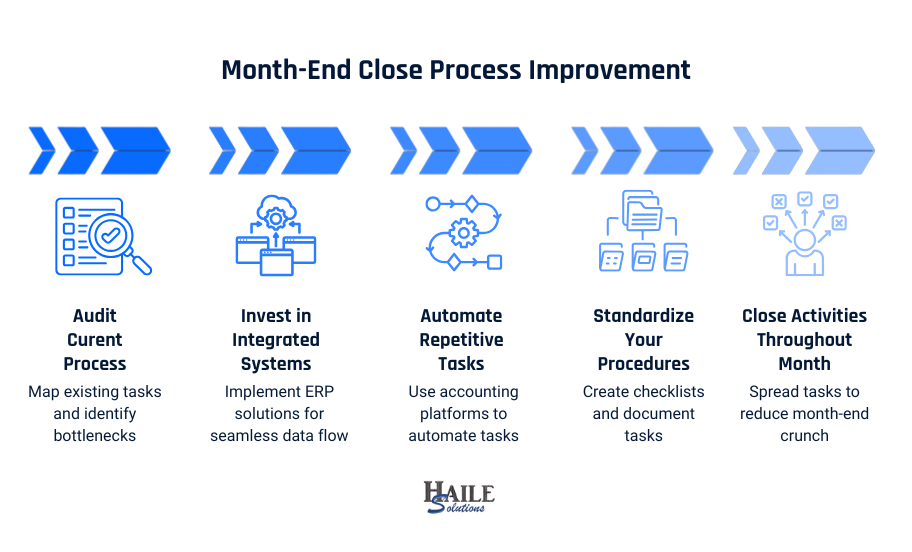
Step 1: Audit Your Current Process
Start by mapping exactly what happens during your current close:
- Who does what tasks?
- How long does each step take?
- Where do bottlenecks occur?
- What manual workarounds exist?
This audit identifies the most significant improvement opportunities.
Step 2: Invest in Integrated Systems
The right ERP system designed for professional services can eliminate most manual data entry. Look for solutions that connect:
- Time and expense tracking
- Project management
- Billing and invoicing
- Financial reporting
Integration is everything. Avoid systems that require manual data transfers.
Step 3: Automate Repetitive Tasks
Modern accounting platforms can automate:
- Bank reconciliations
- Journal entries for recurring items
- Variance analysis between actual and budget
- Basic financial reports
Automation doesn’t just save time. It eliminates human error.
Step 4: Standardize Your Procedures
Create detailed checklists for every close task:
- What needs to be done
- Who’s responsible
- When it’s due
- Quality checks required
Document everything so your process doesn’t depend on specific people.
Step 5: Close Activities Throughout the Month
Don’t wait until month’s end to start closing activities:
- Reconcile accounts weekly
- Review project margins mid-month
- Process expense reports as they come in
- Calculate accruals in advance
Spreading the work reduces the month-end crunch.
Tools and Technology That Actually Help
ERP Systems Built for Professional Services
Solutions like Deltek, NetSuite, or Sage Intacct are designed specifically for project-based businesses. They handle complex scenarios like:
- Multi-phase project billing
- Resource allocation across projects
- Intercompany transactions
- Real-time profitability analysis
Financial Reporting Platforms
If you can’t use a consolidated ERP, tools like Prophix or OneStream can pull data from multiple sources and create automated reports. No more manually building PowerPoint presentations with last month’s data.
Workflow Management
Platforms that track close tasks, send automated reminders, and provide real-time status updates keep everyone aligned and accountable.
Real Results from Professional Services Firms
We’ve seen consulting firms cut their close time from 15 days to 5 days by implementing integrated systems and standardized procedures.
Marketing agencies that automated their expense processing reduced month-end overtime by 60%.
Law firms with proper ERP systems can now provide real-time project profitability reports to partners — something that used to take weeks.
The common thread? These firms stopped accepting broken processes as normal and invested in the right solutions.
Common Mistakes to Avoid
Trying to Fix Everything at Once
Start with the biggest bottlenecks. Success builds momentum for bigger changes.
Ignoring Change Management
Your team needs to understand why changes are happening and how they’ll benefit. Communication is crucial.
If you need a change communication plan template, you can download it here.
Choosing Technology Based on Price Alone
The cheapest solution usually costs more in the long run through inefficiency and workarounds.
Skipping Training
New systems only work if people know how to use them properly. Invest in comprehensive training.
Getting Leadership Buy-In
Present the business case clearly:
- Current close process takes X days and costs Y in overtime
- Proposed solution reduces close time by Z days
- ROI includes faster decision-making, reduced errors, and improved team retention
Connect operational improvements to business outcomes leadership cares about.
Moving Forward: Your Next Steps
Your month-end close doesn’t have to be a monthly crisis. With the right systems, procedures, and mindset, you can transform it into a smooth, predictable process.
Start by auditing your current state. Map out where time is wasted and errors occur. Then prioritize the changes that will deliver the biggest impact.
Remember, every day you delay fixing these problems is another month of stress, overtime, and missed opportunities.
Your team deserves better. Your business deserves better. And your clients deserve better.
The tools and knowledge exist to solve these problems. The question is: when will you stop accepting broken processes as normal?
Frequently Asked Questions
Most professional services firms take 5-10 business days to complete their month-end close, though some organizations require up to 15 days or more. The complexity depends on factors such as firm size, the number of clients and projects, integration between systems, and the level of automation in place.
Professional services firms face unique challenges, including complex project-based billing, tracking time and expenses across multiple engagements, revenue recognition for partially completed projects, and calculating project profitability margins. These factors create more data points to reconcile and validate.
The most common bottlenecks include manual data entry between disconnected systems, time-consuming account reconciliations, waiting for expense reports and timesheets from staff, complex revenue recognition calculations for ongoing projects, and the need to prepare management reports from multiple data sources manually.
Modern ERP systems designed for professional services can automate data integration, streamline reconciliations, provide real-time reporting, and eliminate the need for manual data entry. Features like automated expense processing, integrated time tracking, and AI-powered variance analysis can significantly reduce close time while improving accuracy.
Look for systems with native integration between time tracking, project management, billing, and financial reporting modules. Key features include automated revenue recognition for professional services, real-time project profitability tracking, streamlined expense management, and customizable financial dashboards that eliminate manual report preparation.
We can help in various ways. Firstly, we provide fractional finance support to professional services firms. Our team only works with professional services business so we understand your business, and already use best practice from our years of experience working with businesses that needed to close the month in 5 days or less.
We also specialize in helping professional services firms select and implement the right ERP systems for their specific needs. We provide vendor-neutral guidance to choose systems that actually fit your workflow, comprehensive implementation support to ensure smooth rollouts, and change management expertise to help your team adopt new processes successfully. Our experience with 100+ ERP projects means we know what works for firms like yours.
Yes, absolutely. Automation and integration actually improve accuracy by eliminating manual data entry errors and providing real-time validation. Professional services firms working with Haile Solutions typically see close times reduced by 40-60% while improving data quality and team satisfaction.
The ROI includes direct cost savings from reduced overtime and manual work, faster access to financial insights for better decision-making, improved team retention by eliminating stressful month-end crunches, and better client relationships through more accurate and timely project reporting. Most firms see positive ROI within 6-12 months.
For more insights on modernizing your professional services operations, check out these related resources:
- Empower Your People to Accelerate Month-End Closing – Deltek
- Month End Close Steps, Process, Checklist and Best Practices – Vena
- 9 reasons why your month-end close is challenging | Prophix
- 5 Practical Steps to Modernize Your Month-End Close Process
- How to build a month-end close process | 5 step guide | Mercury