


Your consulting firm just landed its biggest client ever. The contract is worth $500,000. Your team is celebrating. But three months later, you’re scrambling to make payroll. How does a profitable business run out of cash? The answer lies in the silent killers that most professional services firms never see coming. We’ve worked with hundreds of consulting firms, ad agencies, and professional services businesses. The ones that thrive understand one critical truth: profit doesn’t equal cash flow. Those who struggle learn this lesson the hard way.
The Real Cash Flow Crisis in Professional Services
Your Profit & Loss (P&L) statement might show healthy profits, but your bank account tells a different story. This disconnect happens because traditional accounting focuses on when you earn revenue, not when cash actually hits your account.
Professional services businesses face unique cash flow challenges. You invoice for work completed weeks or months ago. Clients pay on their timeline, not yours. Meanwhile, your expenses (payroll, rent, and contractor fees) keep coming in every month like clockwork.
The result?
Even successful firms find themselves cash-strapped, turning down new opportunities or struggling to pay their people on time.
To be fair, cash flow issues are a well-known issue for businesses. A staggering 82% of small businesses fail due to cash flow problems, according to a U.S. Bank study by Jessie Hagen.
In this blog, we run through the major cash flow killers and provide guidance on how to avoid them.
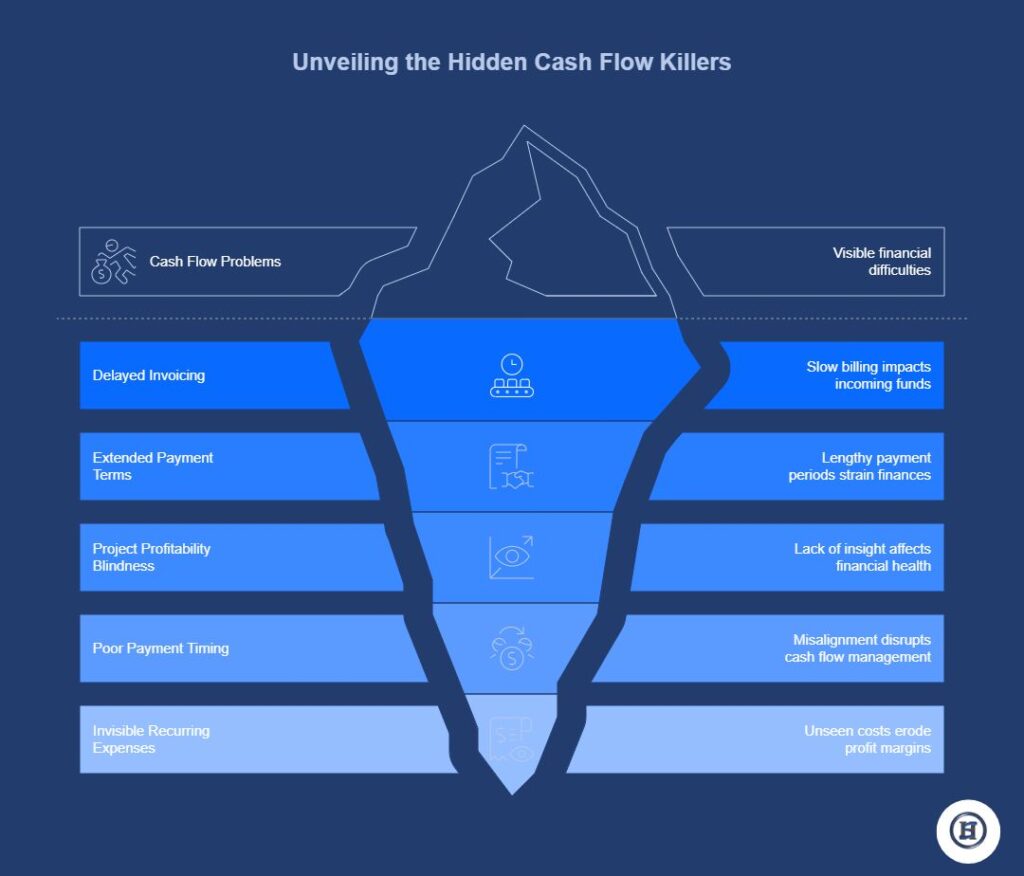
Hidden Cash Flow Killer #1: Delayed Invoicing
Most professional services firms wait too long to send invoices. The invoicing process is cumbersome and inefficient, so invoices that should be issued and sent within hours often take days or weeks to be processed and sent to clients.
Every day you delay invoicing pushes your cash flow further behind. If you typically wait two weeks to invoice and your client pays in 30 days, you’re looking at 44 days between completing work and getting paid.
The real cost of delayed invoicing:
- Lost time value of money
- Increased risk of client payment disputes
- Reduced cash flow predictability
- Higher stress on your finance team
How to fix it: Simplify the invoice process and remove unnecessary steps. Create invoice templates and standardize supporting documentation. Create automated invoicing triggers tied to project milestones. Set up your system to automatically generate invoices as soon as work phases are completed. Finally, your project management software should talk to your billing system without manual intervention. Invoices should be sent directly from the ERP to the client with minimal intervention.
Hidden Cash Flow Killer #2: Extended Payment Terms with Large Clients
Large clients often demand extended payment terms. Net-60 or Net-90 terms might seem worth it for a big contract, but they can destroy your cash flow.
A $200,000 project with Net-90 terms means you’ll finance that client’s work for three months. If your typical project margin is 25%, you’re fronting $150,000 in costs for 90 days.
The hidden cost of extended terms:
- Increased working capital requirements
- Higher credit line usage
- Opportunity cost of tied-up cash
- Greater payment risk over time
Strategies for managing extended terms: Request deposits and/or payments on account. Negotiate milestone-based payments instead of a single payment at completion. For example, a $200,000 project might be divided into either:
- Two installments – 50% at inception and 50% at completion
- Four $50,000 payments, corresponding to 25%, 50%, 75%, and 100% completion.
If you must accept extended terms, factor the financing cost into your pricing. That Net-90 client should pay more than your Net-30 clients.
Hidden Cash Flow Killer #3: Project Profitability Blindness
Many professional services firms can’t tell you which projects actually make money. Without proper time tracking and project accounting, you’re flying blind.
You might think that $100,000 consulting project was profitable. But if your team spent 20% more hours than budgeted, and you didn’t track those hours properly, you might have actually lost money.
Why project profitability matters for cash flow:
- Unprofitable projects drain cash reserves
- You can’t price future work accurately
- Resource allocation becomes guesswork
- You chase the wrong types of clients
Building project profitability visibility: Implement time tracking for all billable team members. Connect time data to project budgets and actual costs. Generate real-time project profitability dashboards.
Most importantly, use this data to make decisions. Stop pursuing project types that consistently lose money. Double down on the most profitable work.
Hidden Cash Flow Killer #4: Poor Payment Timing Alignment
Your biggest expenses hit at the beginning of each month. Payroll, rent, insurance, and contractor payments. But client payments trickle in throughout the month, often clustered around the 15th and 30th.
This timing mismatch forces you to maintain larger cash reserves than necessary. You might have strong monthly cash flow but still face weekly cash crunches.
The timing trap in action:
- Week 1: Payroll due ($50,000), rent due ($8,000), contractor payments ($15,000)
- Week 2: Small client payment arrives ($12,000)
- Week 3: Another small payment ($18,000)
- Week 4: Large client payment finally arrives ($75,000)
You’re profitable for the month, but weeks 1-2 nearly broke you.
How to smooth payment timing: Negotiate staggered payment terms with different clients. If Client A pays on the 15th, try to get Client B to pay on the 1st. Offer small early payment discounts to encourage faster payment.
Consider factoring or invoice financing for large, slow-paying clients. The cost might be worth the cash flow stability.
Hidden Cash Flow Killer #5: Invisible Recurring Expenses
“We’ve seen profitable consulting firms discover $3,000 in monthly subscription leaks they forgot about. That’s $36,000 a year bleeding out silently.”
Software subscriptions multiply like rabbits. That marketing automation tool you tried last year? Still charging your card monthly. The premium Slack plan you upgraded for a big project? Never downgraded when the project ended.
We’ve seen consulting firms discover $2,000-3,000 in monthly recurring charges they “forgot” about. These “subscription leaks” drain cash quietly, month after month.
Common subscription blind spots:
- Software tools that auto-renew annually
- Premium service tiers that are no longer needed
- Multiple tools that serve the same function
- Licenses for employees who left months ago
How to spot and stop subscription leaks: Conduct quarterly subscription audits. Export all transactions from your business credit cards and bank accounts. Flag any recurring charges and verify they’re still needed. Cancel unused subscriptions immediately.
Set calendar reminders before annual renewals. Review each subscription’s value and usage before it auto-renews.
The Technology Solution: Real-Time Cash Flow Visibility
Most professional services firms run on outdated financial systems. They know their cash position from last week or last month, but not today.
Real-time cash flow dashboards change everything. You can see exactly when payments are due, which clients are late, and how much cash you’ll have next week.
Essential cash flow metrics to track:
- Daily cash balance
- 13-week rolling cash flow forecast
- Days sales outstanding (DSO)
- Accounts receivable aging
Modern ERP systems designed for professional services integrate project management, time tracking, and financial reporting. This integration eliminates data silos and gives you complete visibility into your cash position.
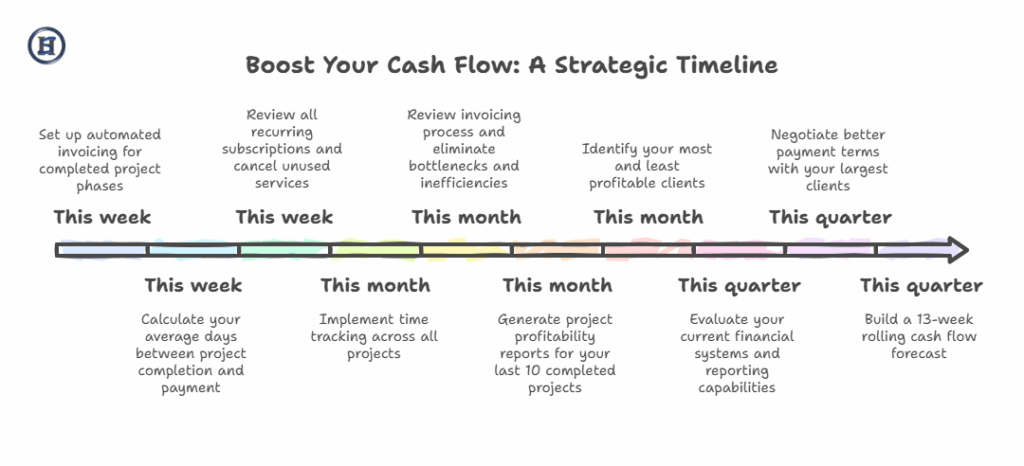
Taking Action: Your Cash Flow Health Check
Start with these immediate actions:
The Bottom Line
Cash flow problems kill more professional services businesses than competition ever will. The killers we’ve outlined aren’t dramatic failures – they’re quiet drains that compound over time.
The good news? Every one of these problems has a solution. The firms that implement these fixes don’t just survive cash flow challenges – they use superior cash flow management as a competitive advantage.
Your next big client contract shouldn’t come with cash flow anxiety. With the right systems and processes, growth becomes sustainable instead of stressful.
Frequently Asked Questions
Industry benchmarks suggest 30-45 days for most professional services work. However, this varies significantly by industry and client size. Law firms often see 60-90 days, while marketing agencies might collect in 15-30 days. The key is measuring your Days Sales Outstanding (DSO) and working to improve it over time.
Profit is calculated when you complete work and send an invoice, regardless of when you get paid. Cash flow is the actual money moving in and out of your bank account. You can be profitable on paper, but still run out of cash if clients pay slowly or you have poor cash management.
Early payment discounts can be effective if structured properly. A 2% discount for payment within 10 days often makes sense if your typical client pays in 45 days. The cost of the discount is usually less than the benefit of improved cash flow and reduced collection efforts. Use these with care, because we’ve seen clients take the early payment discount AND pay late!
Most experts recommend 3-6 months of operating expenses in cash reserves. Professional services firms with highly variable revenue or long payment cycles should aim for the higher end. Firms with predictable monthly recurring revenue can operate with smaller reserves.
Look for integrated time tracking, project-based accounting, automated invoicing, real-time financial dashboards, and accounts receivable management. The system should connect project completion to billing to payment tracking without manual data entry.
We have just started a new “Fractional Finance Team” practice based on client requests. We provide fractional CFOs, controllers, and bookkeepers. Our team exclusively works with professional services businesses and has a deep understanding of the industry.
The biggest mistake is treating cash flow as an accounting problem instead of an operational problem. Cash flow issues usually stem from poor project management, delayed invoicing, or inadequate client payment terms – not just bookkeeping problems. Fixing cash flow requires changes to how you deliver and bill for services, not just better accounting software.