


If you’re running a professional services firm, your financial systems may be draining your time, team morale, and profit margins. It’s not market conditions or competitors that are holding you back; it’s the inefficiency of your current financial systems and processes.
A recent study found that 100% of senior finance and IT decision-makers in professional services firms encounter discrepancies in year-end financials, with 77% experiencing them frequently*. That means every firm in your industry is dealing with financial inefficiencies and most are losing 46 hours per week fixing them.
Here’s how to stop the waste and implement financial systems that actually work for professional services firms.
Why Professional Services Firms Struggle With Financial Systems & Processes
Professional services businesses face unique financial challenges that standard accounting software can’t handle. Your revenue model is complex. You bill by the hour, manage multiple projects simultaneously, and track profitability at the client level.
The Spreadsheet Trap
Most firms start with basic accounting software and Excel spreadsheets. This works when you have five employees and ten clients. But as you scale, these manual financial systems and processes become your biggest bottleneck.
You spend more time collecting financial data than analyzing it. Your team works late nights trying to reconcile project costs. Client invoices go out weeks after project completion because someone needs to manually calculate billable hours across multiple spreadsheets.
Disconnected Systems Create Chaos
Your time tracking system doesn’t talk to your accounting software. Project management happens in one tool while financial reporting happens in another. When systems don’t integrate, data gets lost in translation.
We’ve seen firms where project managers believe they’re profitable, only to have the finance team discover massive cost overruns months later. This disconnect between operations and financial systems undermines your entire business.
The Real Cost of Poor Financial Systems
61% say year-end reporting negatively impacts the well-being of the finance team, while a further 73% say reducing workload at year-end would help prevent burnout.
Your broken financial systems and processes aren’t just inefficient. They’re destroying your team’s morale and preventing strategic decision-making.
What Modern Financial Systems & Processes Look Like
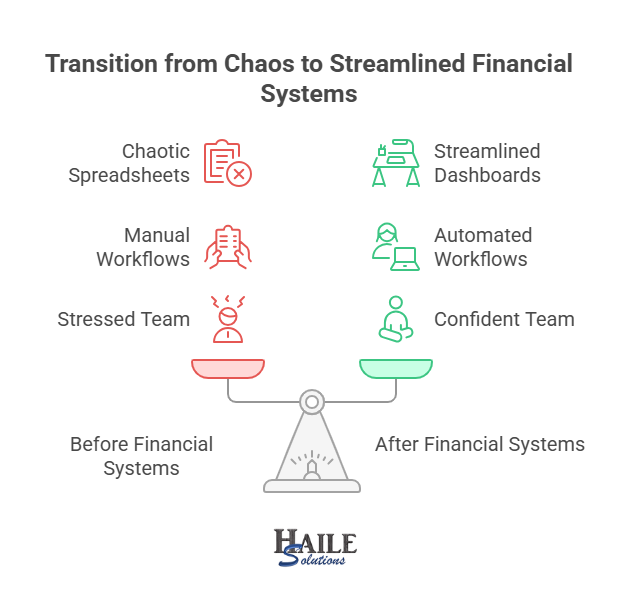
Leading professional services firms have moved beyond spreadsheets and manual processes. They’ve implemented integrated financial systems that automate routine tasks and provide real-time insights.
Integrated Time Tracking and Billing
Your time tracking should automatically flow into your billing system. When consultants log hours, those hours should immediately appear in the appropriate project budget and client invoice.
Modern financial systems calculate project profitability in real-time. You know whether a project is profitable before it’s complete, not months after invoicing.
Automated Accounts Payable and Receivable
ERP systems streamline the entire accounts payable and receivable cycle by automating tasks such as invoice processing, payment approvals, and reconciliations.
Your financial systems should generate invoices automatically based on project milestones or time entries. Payment processing should be seamless, with automated reminders for overdue accounts.
Real-Time Financial Reporting
The best financial systems provide live dashboards showing cash flow, project profitability, and resource utilization. You don’t wait until month-end to understand your financial position.
These systems track key metrics like billable utilization, average project margin, and client lifetime value. You can spot trends before they become problems.
Financial Systems Comparison Table
|
Feature |
Spreadsheets |
Basic Accounting |
Modern ERP/PSA |
|
Real-time Project Profitability |
❌ |
❌ |
✅ |
|
Automated Time Tracking |
❌ |
❌ |
✅ |
|
Integrated Billing |
❌ |
Limited |
✅ |
|
Resource Planning |
❌ |
❌ |
✅ |
|
Financial Reporting |
Manual |
Basic |
Advanced |
How to Transform Your Financial Systems & Processes
Step 1: Audit Your Current Pain Points
Start by documenting where your financial processes break down. How long does it take to generate an invoice? How often do you discover project cost overruns? How many hours does your team spend on manual data entry?
Uncover Financial planning tips that a professional service firm should follow to achieve their financial goals by mapping your current workflows and identifying bottlenecks.
Pro Tip
Use our SOP templates to discover best practices for professional services firms and align your processes accordingly.
Step 2: Choose the Right Financial System
Not all financial systems work for professional services. You need software designed for project-based businesses with features like:
- Project accounting and job costing
- Time and expense tracking
- Resource planning and utilization reporting
- Multi-currency billing capabilities
- Integration with existing business tools
Popular options include NetSuite, Sage Intacct, Microsoft Dynamics 365, and Deltek (Maconomy, Vantagepoint, or WorkBook). Service Performance Insight (SPI) reports that organizations using PSA achieve, on average, 12% higher EBITDA compared to those not using PSA.
Step 3: Standardize Before You Automate
Don’t automate broken processes. 73% of failed implementations occur because firms attempt to digitize inefficient workflows without first addressing their inefficiencies.
Before implementing new financial systems, standardize how your team handles everyday tasks like project setup, time tracking, and invoice approval.
Create clear procedures for project budgeting, change order management, and expense reporting. Your new systems will only be as good as the processes they automate.
Use our SOP templates as reference.
Step 4: Implement in Phases
Don’t try to transform everything at once.
Start with your biggest pain point first. Most firms see immediate ROI by fixing their billing and invoicing processes before tackling advanced features.
Train your team thoroughly on each new process before adding complexity. Change management is crucial for successful financial system implementations.
Step 5: Monitor and Optimize
Track key performance indicators before and after implementation. Measure metrics like:
- Time from project completion to invoice generation
- Days sales outstanding
- Project margin accuracy
- Finance team productivity
Use these metrics to identify areas for further improvement.
Common Implementation Mistakes to Avoid
Underestimating the Time Investment
Implementing new financial systems takes longer than you think. Plan for 3-9 months for a complete transformation, depending on your firm’s complexity. If your firm has multiple offices in multiple geographies, then this will be longer.
Your team will need time to learn new processes. Productivity might dip initially as people adapt to new workflows.
Check out our video on the “8 Phases of an ERP implementation”
Ignoring Change Management
The best financial systems fail when teams resist adoption. Don’t make the same mistake as one of our clients and assume everyone will understand the benefits of the new system.
Involve key stakeholders in the selection process. Communicate the benefits clearly and provide comprehensive training.
Address concerns about job security. Explain how automation will free your team to focus on strategic work instead of manual data entry.
Pro Tip: Download our Change Management Communication Template here
Choosing Features Over Fundamentals
Don’t get distracted by advanced features if your basic financial processes are broken. Focus on core functionality like accurate time tracking, reliable invoicing, and clear financial reporting.
You can add sophisticated features like predictive analytics after your foundation is solid.
The Future of Financial Systems in Professional Services
92% of respondents agree that automating processes would speed up consolidation of year-end financials. Automation isn’t optional anymore. It’s essential for competitive professional services firms.
AI-Powered Financial Analysis
Modern financial systems use artificial intelligence to identify patterns in your data. These systems can predict which projects are likely to go over budget or which clients might have payment delays.
AI helps optimize resource allocation by analyzing historical project data and consultant performance metrics.
Real-Time Collaboration
Cloud-based financial systems enable real-time collaboration between project teams and finance. Project managers can see live budget updates while finance teams get immediate visibility into project progress.
This transparency prevents costly surprises and enables proactive decision-making.
Advanced Forecasting
Optimize resource planning and project profitability with built-in, hyper-accurate forecasting and insights in Salesforce. Leading financial systems provide sophisticated forecasting tools that help you plan capacity, predict cash flow, and model different growth scenarios.
Getting Started With Financial System Transformation
Your current financial systems and processes are holding your firm back. Every day you delay implementation, you lose money to inefficiency and missed opportunities.
Start by evaluating your biggest financial pain points. Document the time your team spends on manual tasks. Calculate the cost of invoice delays and project cost overruns.
Then create a business case for change. The investment in modern financial systems typically pays for itself within 12-18 months through improved efficiency and better decision-making.
Your competitors are already implementing these solutions. The question isn’t whether to modernize your financial systems, but how quickly you can make the transition.
Frequently Asked Questions
Financial systems and processes in professional services encompass the software, procedures, and workflows used to manage project accounting, time tracking, billing, expense management, and financial reporting. These systems track project profitability, automate invoicing, manage cash flow, and provide real-time visibility into financial performance across client engagements.
Signs you need to upgrade include: spending excessive time on manual data entry, frequent discrepancies in financial reports, delayed invoicing, lack of real-time project profitability data, difficulty consolidating financial information, and your finance team working overtime during month-end closes. If you’re using spreadsheets for critical financial processes, it’s time to upgrade.
ERP (Enterprise Resource Planning) systems provide comprehensive business management including financials, HR, and operations. PSA (Professional Services Automation) systems focus specifically on project-based businesses with features like time tracking, project accounting, and resource planning. Many professional services firms use integrated solutions that combine both capabilities.
This is tantamount to asking how long a piece of string is. If your business has one office, implementation typically takes 3-9 months, depending on your firm’s complexity and the scope of changes. This includes system selection, data migration, process standardization, training, and testing. Phased implementations can reduce disruption by starting with core functions like billing before adding advanced features. Large organizations can spend years implementing new systems.
Costs vary widely based on firm size and system complexity. The general rule is that you should spend 2% – 3% of annual revenue on a new ERP implementation and the TCO (Total Cost of Ownership) will be 3% – 6% of annual revenue.
Watch out for the Hidden Costs.
Haile Solutions specializes in helping professional services firms select, implement, and optimize financial systems and processes. We provide end-to-end support, including needs assessment, system selection, process design, change management, and ongoing optimization. Our expertise in ERP and PSA implementations ensures your transformation delivers measurable results and improved profitability.
Ready to transform your financial systems and processes? Haile Solutions can help you eliminate inefficiencies and build the foundation for profitable growth. Contact us to discuss your specific challenges and opportunities.
*The study, titled “The Back Office in 2025”, was commissioned by Unit4 and conducted by Vanson Bourne. The research surveyed 600 senior finance and IT decision-makers in professional services firms across mid-market and enterprise organizations. The study aimed to uncover insights into key challenges and opportunities, particularly those related to modernizing finance systems. The survey was conducted between February 11 and March 10, 2025.