


You’re drowning in disconnected systems. Your sales team can’t see what customer service is doing. Your accounting department still emails spreadsheets back and forth.
Sound familiar?
You’re not alone. Most businesses today operate like digital islands—disconnected, inefficient, and frustrated.
We see this every day. Companies come to us drowning in disconnected systems, wondering why their teams can’t collaborate effectively despite having all the “right” tools.
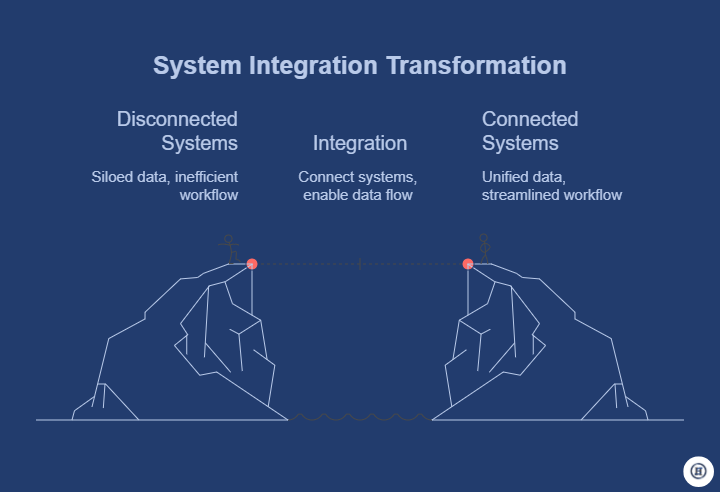
Here’s what we’ve learned: having great tools means nothing if they don’t talk to each other.
Red Flag Alert
If your team emails spreadsheets back and forth, you’re bleeding money and losing competitive advantage
What Is Integration?
Integration connects your company’s various moving parts into a seamless operation.
Think of it as teaching your apps and departments to work together instead of against each other.
When we talk about integration for professional services, we mean two main areas:
Business Service Integration – Getting your software applications to communicate and share data seamlessly
Business Process Integration – Aligning your workflows and automating tasks across different departments
Why does this matter to your bottom line?
Your clients expect fast responses and personalized service. Your teams need real-time information to make smart decisions. Your business needs to adapt quickly to market changes.
None of this happens when your systems work in isolation.
Integration Fact
Most SMB professional services firms use multiple software tools without any coordination between them
The Hidden Cost of Disconnected Systems
Your current approach is bleeding money. Here’s how:
Time Waste
Your team spends hours manually transferring data between systems. That’s billable time lost.
Human Error
Manual data entry creates mistakes. Wrong numbers lead to bad decisions.
Missed Opportunities
When your CRM doesn’t talk to your project management tool, leads fall through the cracks.
Client Frustration
Clients repeat information to different departments because your systems don’t share data.
Reporting Chaos
Month-end close takes forever because you’re pulling data from multiple sources.
How much time does your team waste reconciling different data sources?
Costly Mistake
Buying more software tools without integration only multiplies the chaos and increases monthly subscription costs.
Types of Integration Your Professional Services Firm Needs
Horizontal Integration
Horizontal integration happens when you acquire or merge with a company in the same industry at the same production stage.
This strategy helps you:
- Expand your market share
- Reduce competition
- Achieve economies of scale
- Access new customer bases
Vertical Integration
Vertical integration means acquiring companies at different stages of your supply chain.
You can integrate forward (toward your customers) or backward (toward your suppliers).
Benefits include:
- Better control over your supply chain
- Reduced costs from eliminating middlemen
- Improved quality control
- Faster time to market
Technology Integration
This is where most professional services firms struggle. Your software applications should enhance each other, not compete for attention.
Technology integration connects your tools, allowing them to share data and trigger actions automatically.
The table below summarizes the various integration types.
|
Integration Type |
Best For |
Timeline |
Expected Benefits |
|
Technology Integration |
Daily operations |
2-8 weeks |
20-40% cost reduction |
|
Process Integration |
Workflow efficiency |
2-6 months |
Improved productivity |
|
Business Integration |
Market expansion |
6-18 months |
Market share growth |
Here’s what this looks like in practice:
When a lead fills out your website form, your CRM creates a contact record, your email marketing tool adds them to a nurture sequence, and your sales team gets a notification.
When a support ticket gets created, your help desk assigns it based on expertise, your project management tool creates follow-up tasks, and your customer success team gets visibility into account health.
Quick Win
Start with your most painful disconnection—it often delivers the fastest ROI and team buy-in
The Real Benefits of Professional Services Integration
We’ve helped dozens of companies integrate their operations. Here’s what they consistently tell us about the results:
Reduced Costs
Integration eliminates duplicate systems and processes. You stop paying for multiple tools that do the same job.
Improved Communication
When your systems share data automatically, your team stops passing information back and forth via phone calls.
Your sales team sees customer service tickets in real-time. Your marketing team knows exactly which leads converted. Your finance team gets accurate revenue data without waiting for manual reports.
Increased Security
Fewer systems mean fewer security vulnerabilities. Centralized access controls make it easier to manage who sees what data.
Streamlined Operations
Automated workflows replace manual handoffs. Tasks move smoothly from one department to the next without delays or errors.
Better Client Experience
When your team has complete client information at their fingertips, they provide better service. No more asking clients to repeat information.
Pro Tip
Prioritize integrations by business impact, not technical complexity—simple connections often deliver bigger returns
Why Professional Services Integration Matters More Than Ever
"One of the most significant consequences of the systems integration process is the fact that all relevant and correlated data is aggregated. This means data fetching and processing is much easier and smoother for all subsystems."
GoodCore Software Chief Technology Officer
Your business environment changes faster than ever before.
Client expectations rise constantly. New competitors enter your market regularly. Technology advances at breakneck speed.
Companies that can adapt quickly win. Companies stuck with rigid, disconnected systems fall behind.
Integration enables you to respond to change with agility while maintaining operational efficiency.
When your systems work together, you can:
- Launch new services faster
- Enter new markets more easily
- Scale operations without chaos
- Make data-driven decisions quickly
- Deliver consistent client experiences
Getting Started with Integration
Integration doesn’t happen overnight. It requires planning, investment, and commitment from your leadership team.
Start by auditing your current systems and processes. Map out how data flows (or doesn’t flow) between different tools and departments.
Identify your biggest pain points. Which disconnections cost you the most time, money, or client satisfaction?
Prioritize integrations based on business impact, not technical complexity.
Sometimes the simplest integrations deliver the biggest returns.
Did You Know
Simple integrations often deliver bigger returns than complex enterprise solutions because they solve immediate pain points
Step 1: Inventory Your Current Tools
List every software application your team uses. Include:
- CRM systems
- Project management tools
- Financial software
- Communication platforms
- Time tracking applications
- Document management systems
Step 2: Map Your Workflows
Document how work flows through your organization. Where do handoffs happen? What information gets lost in translation?
Step 3: Identify Integration Opportunities
Look for places where automatic data sharing would eliminate manual work or reduce errors.
Step 4: Start Small
Pick one integration that will have an immediate impact. Success builds momentum for larger projects.
Warning
Don’t try to integrate everything at once—this leads to overwhelmed teams and project failure
Common Integration Challenges for Professional Services
Resistance to Change
Your team is comfortable with current processes, even if they’re inefficient. Change management is crucial for successful integration.
Data Quality Issues
Integration exposes data problems you didn’t know existed. Clean data is essential before connecting systems.
Technical Complexity
Some integrations require custom development. Others work with simple tools like Zapier.
Cost Concerns
Integration requires upfront investment. Focus on projects with clear ROI to get buy-in.
Success Strategy
Calculate the cost of NOT integrating—manual work, errors, and missed opportunities often exceed integration costs
Frequently Asked Questions
Integration for professional services connects your company’s systems, processes, and departments to work as a unified operation. You need it because disconnected tools and workflows create inefficiencies, communication gaps, and missed opportunities that hurt your bottom line. Professional services firms especially benefit because you’re selling time and expertise—wasted time directly impacts profitability.
We start by understanding your business goals and current pain points. We then audit your existing systems and processes to identify opportunities for integration. We prioritize projects based on business impact and create a roadmap that delivers quick wins while building toward long-term objectives. Our approach is vendor-neutral, ensuring you get the right solution for your specific needs.
Business service integration connects your software applications so they share data and trigger actions automatically. Business process integration aligns your workflows and procedures across departments to eliminate handoffs and bottlenecks. Most successful integration projects address both areas.
Project timelines vary based on complexity and scope. Simple software integrations can be completed in weeks, while comprehensive process integration initiatives may take several months. We break larger projects into phases so you see benefits throughout the implementation.
Our clients typically see cost reductions from eliminating duplicate systems and manual processes. They also report improvements in productivity, faster decision-making, and enhanced client satisfaction. The exact ROI depends on your current inefficiencies and integration scope, but most firms see measurable results within 90 days.
Not necessarily. We often integrate existing systems using APIs, middleware, or custom connectors to enhance their functionality. We only recommend system replacement when your current tools can’t support your business requirements or integration needs. Our vendor-neutral approach ensures we recommend the right solution, not the most expensive one.
We follow industry-standard security practices including encrypted data transmission, role-based access controls, and comprehensive audit trails. We also conduct security assessments before connecting any systems and provide ongoing monitoring recommendations. Your data security is paramount throughout the integration process.
Ready to Transform Your Professional Services Operations?
You’ve built a successful professional services firm. Now it’s time to scale it intelligently.
Integration isn’t just about connecting software. It’s about creating an operation that works as hard as you do.
Stop fighting your technology and start leveraging it.
Related Resources: