


Your team just delivered another successful project on time. The client is thrilled. The invoice is paid. And yet, your profit margin barely breaks double digits.
And that’s what keeps you up at night: agencies above 25 FTEs have an average of 13% project profitability. Thirteen percent. That’s razor-thin margins in an industry where project complexity keeps growing and client expectations keep rising.
If you’re running a professional services firm (whether you’re a marketing agency, consulting practice, or architecture firm), you know this feeling. Revenue flows in, but profit feels elusive. You’re busy, your team is stretched, and somehow the numbers at the end of the month don’t reflect all that hustle.
We see this every day with our clients. They’re doing the work, billing the hours, and keeping clients happy. But they’re missing the critical piece: understanding project profitability and pricing strategies that actually drive sustainable growth.
What Project Profitability Really Means for Your Business
Project profitability is a measurement used to assess a project’s return after all expenses are deducted. But in professional services, it goes deeper than simple math.
Project profitability tells you which types of work make you money and which ones drain your resources. It reveals whether your pricing strategies align with your delivery costs. Most importantly, it shows you where to focus your business development efforts.
The Hidden Costs Killing Your Margins
Most firm leaders focus on obvious costs: salaries, software, and office rent. But the real profit killers hide in plain sight:

- Scope creep that adds 20-30% to project delivery time
- Inefficient time tracking that misses billable hours
- Poor resource allocation that has senior people doing junior work
- Disconnected systems that require manual reporting and reconciliation
- Change orders handled poorly or not tracked properly
We recently worked with a Latam-based marketing agency. On paper, they had healthy revenue growth. In reality, their project margins were getting thinner each quarter. The culprit? They were pricing based on competitor rates, not their actual delivery costs.
How to Calculate Project Profitability That Actually Matters
Forget the complex formulas, you don’t have time for. Here’s the straightforward approach we use with our clients:
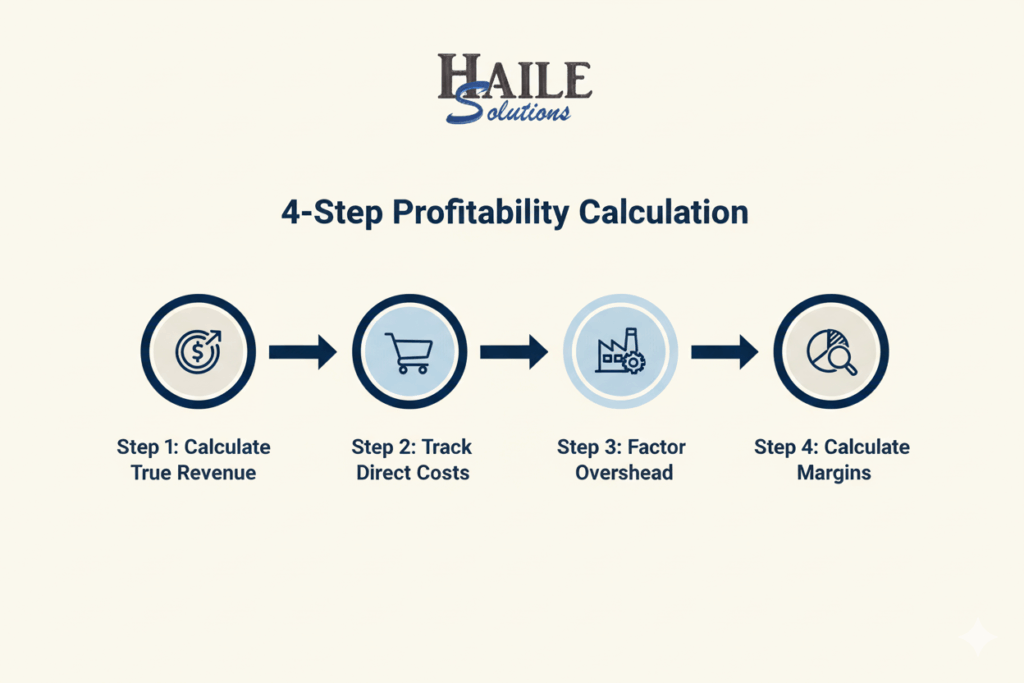
Step 1: Calculate Your True Project Revenue
Start with what the client pays you. But include everything:
- Base project fee
- Approved change orders
- Additional services delivered
- Any performance bonuses or incentives
Don’t just look at the contract value. Look at what actually hit your bank account for this specific project.
Step 2: Track All Direct Project Costs
Direct costs are expenses directly tied to delivering the project, including labor costs, contractor fees, and project-specific expenses.
Calculate labor costs by multiplying each team member’s hours by their fully loaded hourly rate (salary plus benefits divided by billable hours). We have a template for that, which you can download here.
Add contractor costs and any project-specific expenses like travel, software licenses, or materials.
Step 3: Factor in Your Overhead Allocation
Here’s where most firms get it wrong. They either ignore overhead or allocate it incorrectly.
Take your monthly overhead (rent, admin salaries, insurance, general software costs) and divide by your total billable hours that month. This gives you an overhead rate per hour. Multiply this by the total hours spent on the project.
Our template helps you calculate this automatically.
Step 4: Calculate Your Gross and Net Profit Margins
Gross profit examines your project’s profitability by taking into account direct costs only, while net profit includes all costs, including overhead.
Gross Profit Margin = (Revenue – Direct Costs) / Revenue × 100
Net Profit Margin = (Revenue – All Costs) / Revenue × 100
In professional services, a good gross profit margin typically ranges from 55% to 70%, while a net profit margin of 15% to 25% is considered strong.
Table 1: Industry Benchmark Profit Margins
| Service Type | Gross Margin Range | Net Margin Range | Notes |
| Marketing Agencies | 45-65% | 15-25% | Higher for specialized services |
| Management Consulting | 50-70% | 20-30% | Premium for expertise |
| Architecture/Engineering | 35-55% | 12-22% | Material costs impact margins |
| Legal Services | 60-75% | 25-35% | High billable hour rates |
Pricing Strategies That Drive Profitability
Your pricing strategy should reflect your value, not just your costs or competitor rates. Here’s how we help our clients think about pricing:
Value-Based Pricing vs. Cost-Plus Pricing
Value-based pricing generates increased profits by focusing on client outcomes rather than just covering your costs with a markup.
Instead of calculating your costs and adding 20%, focus on the value you create for clients. A marketing campaign that generates $500K in new revenue justifies premium pricing. Improving processes that save a client $100K annually opens up value-based conversations.
The added bonus of value-based pricing is that it automatically positions you as a valued partner vs. a vendor.
The Three-Tier Pricing Framework
Offer clients options that make your preferred pricing look reasonable:
- Basic package: Covers essential deliverables at your minimum viable margin.
- Standard package: Your preferred option with better margins and additional value
- Premium package: Everything included plus strategic extras
Giving clients a choice looks better than just stating your price. The premium option makes your standard package feel like the smart middle choice.
Project vs. Retainer Pricing Considerations
Each model has profitability implications:
Project-based pricing gives you flexibility to charge premium rates for specialized work, but creates revenue volatility and requires constant business development.
Retainer models provide predictable revenue and stronger client relationships, but require careful scope management to maintain margins.
Many successful firms use a hybrid approach: retainers for ongoing services with project pricing for special initiatives.
Common Profitability Killers We See Every Day
Poor Project Scoping
32.2% of respondents in one survey said clients changing their minds was their biggest barrier to productivity. Scope creep doesn’t just delay projects; it destroys profitability.
Define project scope clearly upfront. Include assumptions, deliverables, and what’s explicitly not included.
Pro Tip
Have a formal change order process that requires written approval and additional payment. Include the process in the contract.
Inefficient Resource Allocation
Senior people doing junior work kills margins faster than anything else. A partner billing at $500/hour shouldn’t be formatting PowerPoint slides, but I see this task listed all the time on timesheet reports.
Track who’s doing what work. Build teams with the right mix of experience levels. Create clear guidelines about which team members handle which types of tasks.
Pricing Based on Fear
This is a big one! We see firm leaders consistently underpricing because they’re afraid to lose opportunities. This creates a downward spiral where low margins mean you can’t invest in better people or systems.
Price confidently based on value delivered. If prospects consistently say you’re too expensive, either you’re targeting the wrong market or not communicating value effectively.
Building Systems That Support Profitable Projects
Profitability doesn’t happen by accident. It requires systems that give you visibility and control.
Real-Time Project Tracking
You need to know where you stand on every project while there’s still time to course-correct. This means:
- Time tracking that team members actually use
- Budget burn rates updated weekly
- Milestone-based progress reviews
- Early warning systems for projects trending over budget
Integrated Financial Reporting
Disconnected systems kill profitability visibility. Your time tracking should feed your accounting system. Your project management tools should connect to your invoicing. Everything should flow into real-time profitability dashboards.
This is where many firms need help. The right ERP system connects all these pieces and gives you the visibility you need to make smart decisions.
If we need assistance in assessing your current ERP or selecting a new one. We have a bunch of resources on our website. You can find them here.
Margin Protection Processes
Build safeguards into your delivery process:
- Scope change approval workflows
- Regular project health checks
- Client communication protocols
- Resource allocation reviews
When to Get Help with Project Profitability
Some profitability challenges require outside expertise:
ERP Selection and Implementation: If you’re tracking profitability in spreadsheets or your current systems don’t talk to each other, you need integrated project management and financial systems.
Pricing Strategy Development: If you’re competing primarily on price or margins keep shrinking, you need help developing value-based pricing models.
Process Optimization: If projects consistently run over budget or timeline, you need structured process improvement.
Financial Systems Integration: If month-end reporting takes weeks and you don’t trust your numbers, you need systems that provide real-time visibility.
We help professional services firms with all these challenges. Our approach means we recommend what actually fits your business, not what pays us the highest commission.
Making Project Profitability a Competitive Advantage
The firms that consistently deliver profitable projects share common characteristics:
- They know their numbers in real-time
- They price based on value, not just costs
- They have systems that support efficient delivery
- They protect margins through disciplined project management
- They continuously improve based on profitability data
This isn’t about becoming the cheapest option in your market. It’s about becoming the most valuable and pricing accordingly.
Your profitability data should inform every business decision: which clients to pursue, which services to emphasize, which team members to develop, and which processes to improve.
The Path Forward
Project profitability isn’t just about better accounting. It’s about building a business that can invest in growth, attract top talent, and deliver exceptional value to clients.
Start with measurement. You can’t improve what you don’t track. Get clear visibility into which projects make money and which ones don’t.
Then optimize. Fix the processes that drain profitability. Adjust pricing strategies that don’t reflect value. Invest in systems that support efficient delivery.
Your firm has the expertise clients need. With the right profitability focus, you can build a business that reflects that expertise in sustainable margins and strategic growth.
Frequently Asked Questions
In professional services, a good gross profit margin typically ranges from 55% to 70%, while a net profit margin of 15% to 25% is considered strong. However, margins vary significantly by industry and service type. Marketing agencies might see different margins than engineering consultancies. The key is benchmarking against your historical performance and industry standards while continuously working to improve efficiency.
For retainer work, calculate profitability by allocating the monthly retainer amount across the work delivered. Track all hours and costs associated with retainer deliverables during the period. Divide the retainer fee by hours worked to get your effective hourly rate, then compare this to your fully loaded cost per hour. Factor in any additional expenses or overhead allocation to determine true profitability.
Project-based pricing offers higher potential margins for specialized work but creates revenue volatility and requires constant sales efforts. Retainer pricing provides predictable cash flow and deeper client relationships but requires careful scope management to prevent margin erosion. Many successful firms use hybrid models: retainers for ongoing services with project premiums for special initiatives.
Focus on operational efficiency: eliminate scope creep through better project scoping, optimize resource allocation by matching skill levels to tasks, reduce overhead through system integration, and improve time tracking accuracy. We recommend aiming for a delivery margin of 60-70% per project to ensure your projects generate enough profit to cover other business expenses. Sometimes, profitability improvement comes from doing the same work more efficiently rather than charging more. profitability.
ERP systems provide integrated visibility across time tracking, project management, and financial reporting. This eliminates manual data entry, reduces reporting errors, and gives real-time insight into project performance. The right ERP helps you track resource utilization, monitor budget burn rates, and identify profitability trends across different project types and clients. For professional services firms, this visibility is crucial for making informed pricing and resource allocation decisions.
It’s all about effective communication. Prevent scope creep by clearly defining project scoping upfront, including detailed deliverables, assumptions, and explicit exclusions. Establish a formal change order process that documents additional work and associated costs. 32.2% of respondents in one survey said clients changing their minds was their biggest barrier to productivity. Frame scope discussions as protecting project success and timeline commitments rather than just protecting your margins.
Consider expert help when: your margins are consistently below industry standards, you’re competing primarily on price, projects regularly exceed budgets, you lack real-time profitability visibility, or you’re experiencing rapid growth but declining margins. If you’re tracking profitability in spreadsheets or your systems don’t provide integrated project and financial data, professional guidance can help you implement systems that support sustainable